
Gaming Has Grown Up: What That Means for Brands
55 percent of people in Germany play games, and the 50 plus group is growing fastest. Why branded games now reach far more than a young audience and how the game becomes part of the campaign.
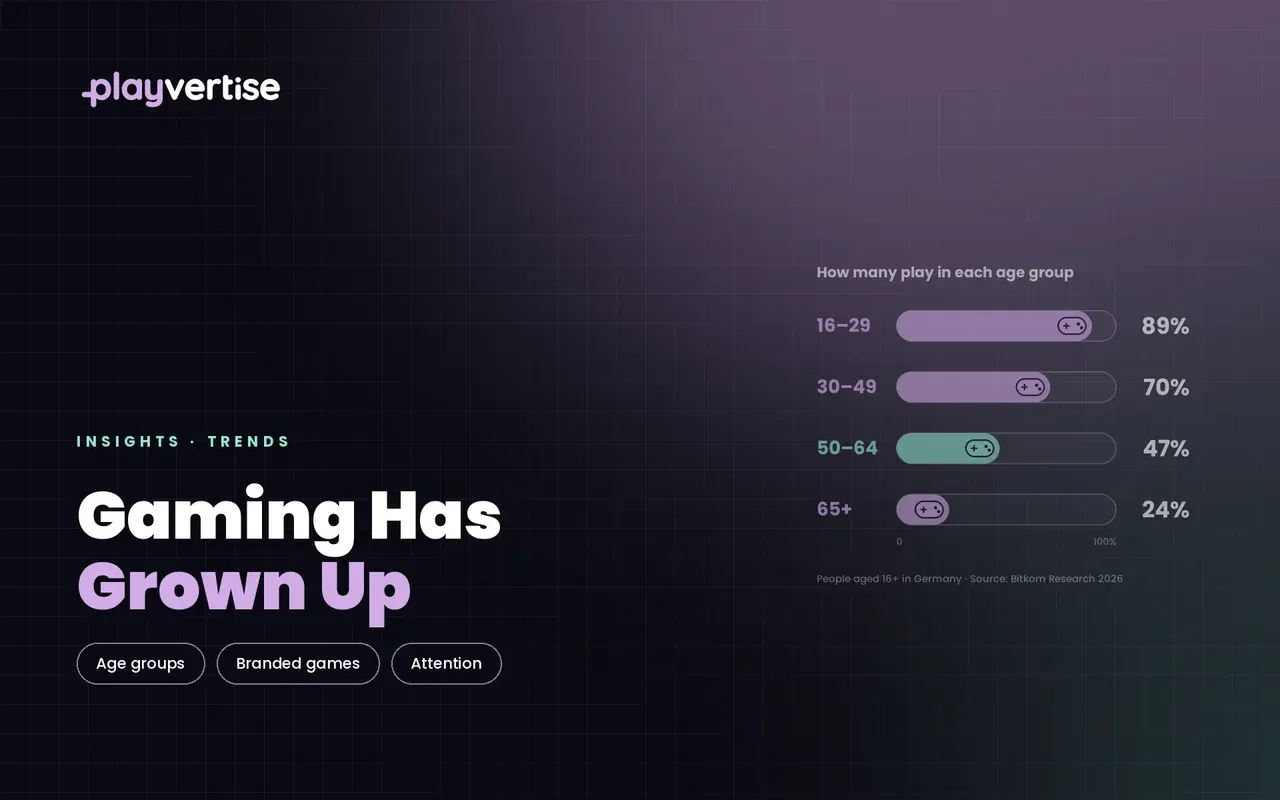
For a long time, games were seen as something for teenagers. That picture no longer holds. In Germany, 55 percent of everyone aged 16 and over play at least now and then, around 39 million people (Bitkom, 2026a). Five years ago the share was 50 percent. More important for brands than the total: gaming now runs through every age group, and that changes how games can be used in marketing.
From Gen Z to the over-65s
89 percent of 16 to 29 year olds play, 70 percent of 30 to 49 year olds, 47 percent of 50 to 64 year olds and 24 percent of people over 65 (Bitkom, 2026a). Every one of these groups grew compared with the previous year, and the biggest jump came from the 50 to 64 year olds, up from 41 to 47 percent (Bitkom, 2026b).
There is a reason the older groups are catching up. Anyone who played their first console games on the Nintendo Entertainment System as a teenager is now in their fifties. That first generation of gamers is reaching middle age, and many of them have kept playing (Kakulla, 2025). With every year, the generation that grew up with games moves further into the older age groups.
Bitkom's CEO Bernhard Rohleder sums it up: gaming has reached the breadth of society and has been firmly anchored there for years (Bitkom, 2026a). For brands, a game is therefore no longer a format for one young target group. The parents at the family day, the purchasing manager at the trade fair and the regular customer in the store increasingly play themselves. The question is how to reach them.
Attention is shared at every age
Advertising competes for attention with the phone in people's hands, and not only among the young. In the US, 52 percent of 45 to 54 year olds watch videos on their phone while the TV is running, up from 39 percent in 2022 (Omdia, 2026). The second screen has long stopped being a habit of younger audiences.
A game turns that phone from a distraction into the way in. And an ad people play works differently from one they only look at. In an experiment published in the Journal of Interactive Advertising, people who played a short branded game found the experience more satisfying than those who saw a static ad with the same message. They also engaged more strongly with the brand, above all emotionally (van Berlo & Chen, 2024).
With an audience this broad, one thing matters most: taking part has to be easy wherever people meet the game, without an app and without anyone needing an explanation, whether they are 20 or 70. The big platforms have understood exactly that.
The big platforms have noticed
LinkedIn now offers eight daily puzzle games. According to LinkedIn, 86 percent of members who play come back the next day, and 82 percent are still playing a week later (Hutchinson, 2026). YouTube launched Playables in 2024, with more than 75 games that can be played directly on the platform (YouTube, 2024). And Netflix has added games to its offer as well (Seppala, 2025).
None of these platforms is a games company, and none of them sends people to a separate gaming app. LinkedIn put its puzzles into the app people open for work, YouTube placed its games next to the videos, Netflix next to its films and series. The game sits where people of every age already spend their time, and LinkedIn's return rates show the effect: people come back for it.
The game becomes part of the campaign
For brands, the game can become part of the advertising people already see, and one campaign often uses several placements at once:
- On-Screen: the game joins the spot on a large screen, in screen advertising, at trade fairs, in retail and at events. The spot keeps running, the game adds the interactive layer, and the phone becomes the remote.
- Web & Social Media: the game starts straight from the post, the website, the newsletter or a QR code, with game and controls on one device.
- Display Ads: next up are playable display ads for Google DV360, built for programmatic campaigns and retargeting. Development is already underway.
Because the game carries the look of the campaign, from logo and colors to sprites and prizes, it reads as part of the advertising rather than an add-on next to it. People do not leave the campaign to play, they play inside it. The platform covers games, quizzes and product finders, data is hosted in the EU, small changes can be made by you directly, and every participation is counted.
That way the game reaches people of every age exactly where the campaign already finds them.
Bottom line
Gaming has grown up. It runs through every age group, and each year the generation that grew up playing moves further up the age scale. For brands, that means a game can move people of every age from scrolling on the side to playing along.
That is what playvertise is built for. With us, the game becomes part of your campaign: on the big screen, in the feed and in the newsletter, and soon as playable display ads as well. No app, no code, live in a short time, and branded from the characters to the prizes.
Curious what your brand would look like as a game? Let's talk at playvertise.eu.
Sources
- Bitkom. (2026a, August 19). Deutschland spielt: Rund 39 Millionen sind Gamer [Germany plays: around 39 million are gamers] [Press release]. Representative telephone survey by Bitkom Research, n = 1,205 people aged 16 and over, of whom 663 gamers, calendar weeks 20 to 24, 2026. bitkom.org
- Bitkom. (2026b, August 20). Gaming in Deutschland 2026 [Press conference presentation by B. Rohleder]. Data: Bitkom Research 2026. bitkom.org
- Hutchinson, A. (2026, June 10). LinkedIn launches its eighth puzzle game. Social Media Today. socialmediatoday.com
- Kakulla, B. (2025, March). Aging in play: Representations of age in video games. AARP Research. doi.org
- Omdia. (2026, March 11). More than half of 45–54 year olds now watch mobile video while watching TV [Press release]. US consumer research. omdia.tech.informa.com
- Seppala, T. J. (2025, December 8). Game night upgrade: Netflix games just arrived on your TV. Netflix Tudum. netflix.com
- van Berlo, Z. M. C. & Chen, X. (2024). Advergames and consumer brand engagement: Experiential satisfaction as a mediator of gamified advertising effects. Journal of Interactive Advertising, 24(3), 238–246. doi.org
- YouTube. (2024, May 28). Playables are now on YouTube. YouTube Official Blog. blog.youtube
Want to try this idea as a campaign?
We translate the idea from this article into a concrete game setup, tailored to your channel and budget.
20 minutes via video call, no obligation. We usually answer requests within 24 hours.