
Our Vision: Gamification for Everyone, and Why We Are Rethinking Interactive Advertising
With playvertise, we are pursuing a clear vision: gamification should be simple, accessible and usable directly on existing screens.
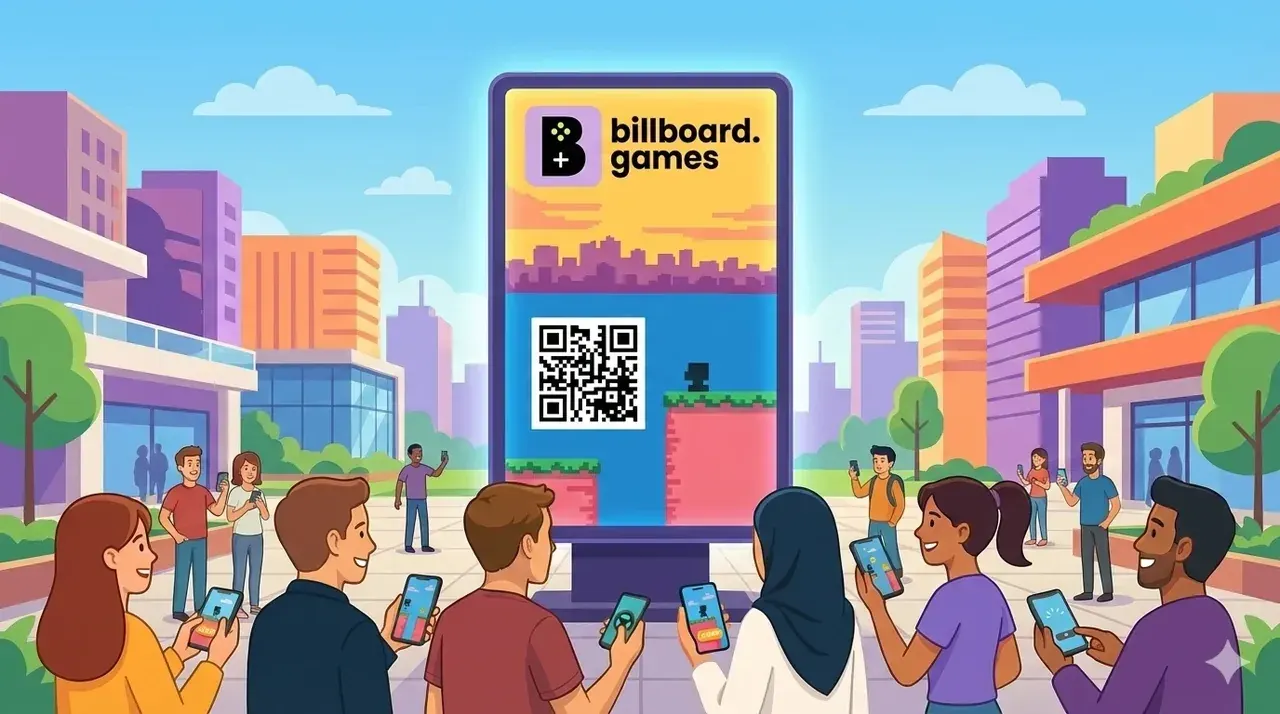
With playvertise, our goal is to make gamification as simple and accessible as possible. Screens should not only display content, but invite active participation, whether in public spaces, retail, trade shows or events.
Our approach is deliberately low-threshold. A QR code is enough to interact directly in the browser with a smartphone. No app, no installation, no additional hardware. The smartphone becomes the controller, the screen becomes the playing field.
We do not see gamification as a short-term effect, but as a sustainable tool for increasing attention, dwell time and participation. Our vision is to make interactive screen formats available for as many use cases as possible.
What “for everyone” means in practice
“Gamification for everyone” is not a slogan for us but a list of barriers we want to remove. For a long time, a game on a screen meant briefing an agency, commissioning development, renting hardware and waiting for weeks. Big brands could afford that for their one big appearance. For a mid-sized company’s trade show booth, a branch or a shop window, it was too expensive and too slow.
We want a branded game to become as natural as a banner or a video spot. That takes three things:
- No barrier for players. A QR code, their own phone, the browser. Anyone who has to download an app first doesn’t play.
- No barrier for the technology. A screen with a browser is enough, from the TV at the booth to a network of DOOH screens. The games run in the players that are already in use, such as Grassfish, Yodeck or Xibo.
- No barrier for marketing teams. Games from a library, branded in your own GameHub, without code and without a development project.
From billboard to platform
We started out as billboard.games with one picture in mind: the advertising screen that plays back. It quickly became more. During the Ö3 Wake-Up Challenge, commuters at 18 train stations voted live from their phones. Bosch Professional had passers-by on Vienna’s Mariahilfer Straße drive screws in their own drill game for a week. The Dragee Keksi promotion at Vienna universities won two bronze awards at the VAMP Award.
Every activation added new channels: trade show booths, shop windows, events, social ads, newsletters and websites. That is why we have been called playvertise since June 2026: the old name only described part of what brands do with us. More in the post billboard.games becomes playvertise.
What the vision looks like today
Today more than 100 brands play with playvertise, adding up to over 300,000 plays. The building blocks are the same, just broader:
- Screen Play: the game on the big screen, controlled by phone, at the trade show booth, in the shop window or in a DOOH network.
- Web & Social: the game entirely in the phone browser, via link, QR code or embedded in your own website.
- Live Wall: the photo wall where guests become the content with their own pictures.
- GameHub: one login for game, branding, prizes, lead fields and reporting.
The range shows that the idea works. Bosch Professional and T-Systems use their own games to make products and topics tangible. Landtmann’s Original and FRIPAC-MEDIS use spin the wheel for prize moments at their trade show booths. Agencies such as e|motion group and Chaka2 build playvertise into their own activations. For us, that is the best proof that gamification is no longer a question of budget size.
What we deliberately avoid: games for their own sake. Every round should do something for the brand, whether that is attention at the booth, a contact with consent or a product someone understood because they tried it themselves.
Where we are heading
Our goal is the same as on day one: every screen people walk past should be able to become playable, and every brand should be able to use that without a big project. That means more games in the library, new formats like the digital advent calendar and a platform that presents results in a way that fits into any campaign plan.
If you want to see what that looks like for your brand, browse the game library or get in touch.
More about it: Trending Topics
Want to try this idea as a campaign?
We translate the idea from this article into a concrete game setup, tailored to your channel and budget.
20 minutes via video call, no obligation. We usually answer requests within 24 hours.