playvertise or Leadfamly (now Playable): the Comparison
Leadfamly has been called Playable since 2022 and is one of the well-known gamification platforms for online campaigns. How playvertise differs, when each tool fits and what matters in the comparison.
Anyone looking for a gamification platform comes across Leadfamly sooner or later. The Danish provider has been called Playable since October 2022, but many people still search under the old name. In this post we compare Playable with playvertise.
To be upfront: playvertise is our own product. We still try to be fair and say what each tool is best suited for. The information about Playable comes from its website, as of October 2026.
A quick introduction
Playable (formerly Leadfamly) was founded in Aarhus in 2017 and describes itself as self-service gamification software for marketing campaigns. According to its website, more than 40 game types are available, including a wheel of fortune, Hit a Mole and Drop Game. The focus is on campaigns across paid, owned and earned channels and on zero-party data for personalization and segmentation. Playable names more than 650 brands as customers, including Carlsberg, Icelandair and Arla.
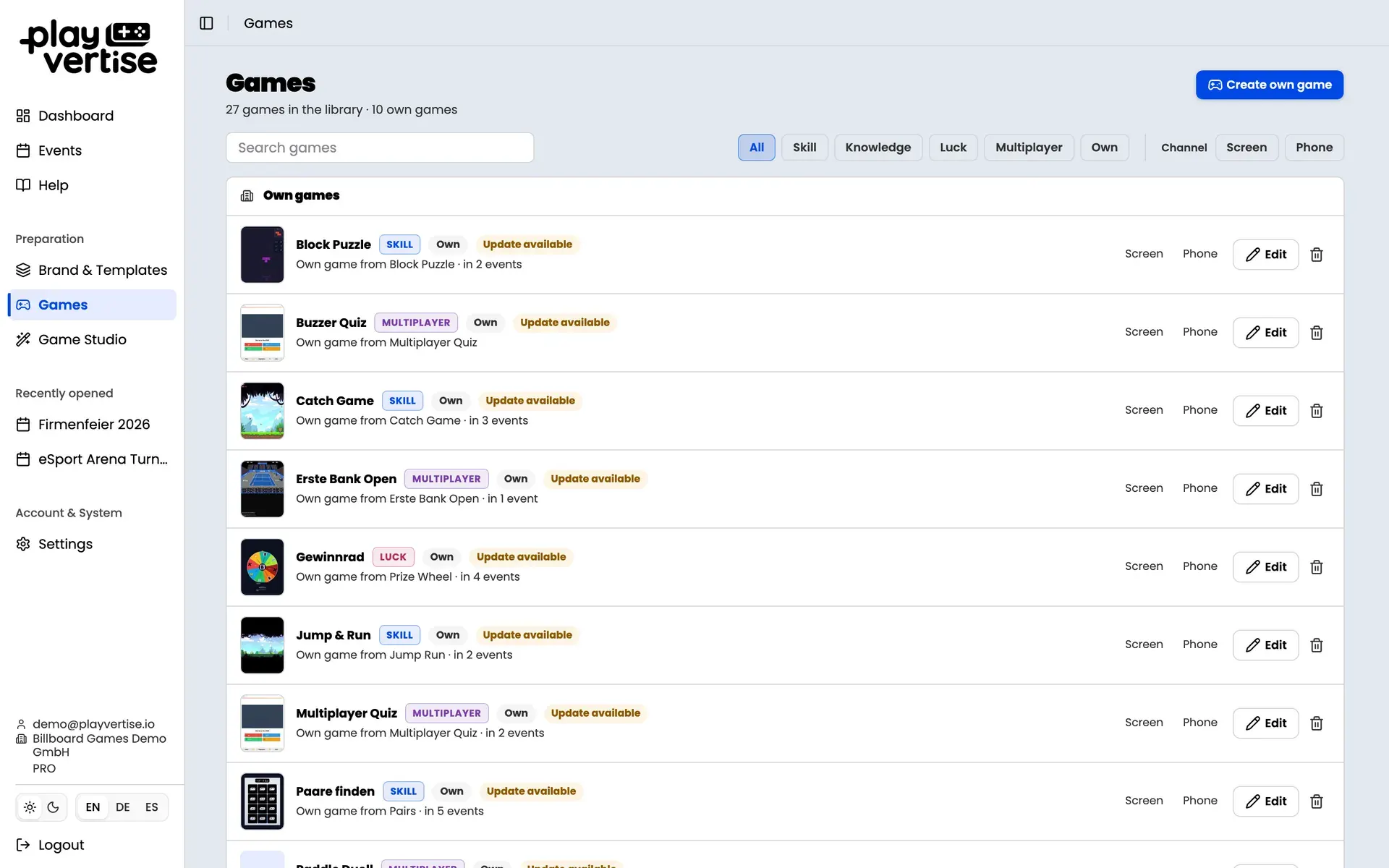
playvertise comes from Vienna and grew out of billboard.games. The platform is called GameHub and was built for two situations: the game on a big screen, controlled by phone, and the game right in the phone browser or on a website. More than 100 brands play with playvertise, adding up to over 300,000 plays.
The biggest difference: screen or phone
Both platforms bring games into campaigns, with lead capture and a dashboard. The difference is where people play.
Playable is geared to digital campaigns: website, newsletter, social and paid media. If you mainly run giveaways and games online, you will find a large selection there.
playvertise covers these channels too with Web & Social, but it was built for screen and phone together. With On-Screen the game runs on the big screen, at a trade show booth, in a shop window or in a DOOH network, and visitors control it with their own phone, alone or in multiplayer. The games run in players such as Grassfish, Yodeck or Xibo. On top of that there is the Live Wall, a photo wall for events.
Compared on five points
| Playable (formerly Leadfamly) | playvertise | |
|---|---|---|
| Channels | Website, newsletter, social, paid media | Website, newsletter, social, plus the big screen with phone control: trade shows, shop windows, DOOH, events |
| Games | 40+ game types according to its website | around 25 games in the library, plus custom games |
| Data | Zero-party data, integrations depending on plan: standard, webhook, API | Lead fields with consent, real-time dashboard, CSV export, CRM connection as an add-on |
| Pricing | Essentials, Core and Premium plans with unlimited campaigns, prices on request | Public prices with a calculator, e.g. trade show package from €1,850 net, mobile campaign from €2,200 plus €60 a month |
| Based in | Aarhus, Denmark | Vienna, Austria |
When Playable fits
If your campaigns run almost entirely online, you plan many activations a year and you want a large choice of game types, Playable is an obvious choice. Teams that mainly use games for zero-party data and segmentation in their CRM, and want a dedicated customer success contact, will also find suitable plans there.
When playvertise fits
As soon as a screen comes into play, the question changes. A trade show booth, shop window, store screen or DOOH campaign needs a game that runs on the big screen and is controlled by phone, without an app or extra hardware. That is exactly what playvertise was built for. Examples include the FRIPAC-MEDIS spin the wheel at Top Hair 2026 with more than 600 prizes in two show days, or the Stibitzer campaign on 57 DOOH screens.
On top of that, a game branded once in the GameHub runs on screens, phones and websites during the license, without being rebuilt. And if you want to cover a single trade show without an ongoing license, the trade show package gives you a flat price.
What to look for in a comparison
- Where will people play? Only online, or also on screens on site?
- How deep does the branding go? Logo and colors, or also game characters, prizes and copy?
- What happens to the data? Consents, export, CRM connection and where it is stored.
- How is it billed? Public prices or a quote, a license or a flat fee per activation.
For a broader overview of other providers, see our post The 5 best gamification tools for brands in 2026. If you want to see playvertise for yourself, browse the game library or ask us for a demo.
Note: the information about Playable is based on playable.com as of October 2026. Features and offers change, so check the current status before making a decision.
Want to try this idea as a campaign?
We translate the idea from this article into a concrete game setup, tailored to your channel and budget.
No obligation, on a video call