
Giveaways at Trade Shows: The Legal and Practical Side
A giveaway at the trade show booth brings footfall and contacts, but it raises questions: terms of participation, consent, levies. What applies in Austria and Germany, and how a giveaway runs smoothly at the booth.
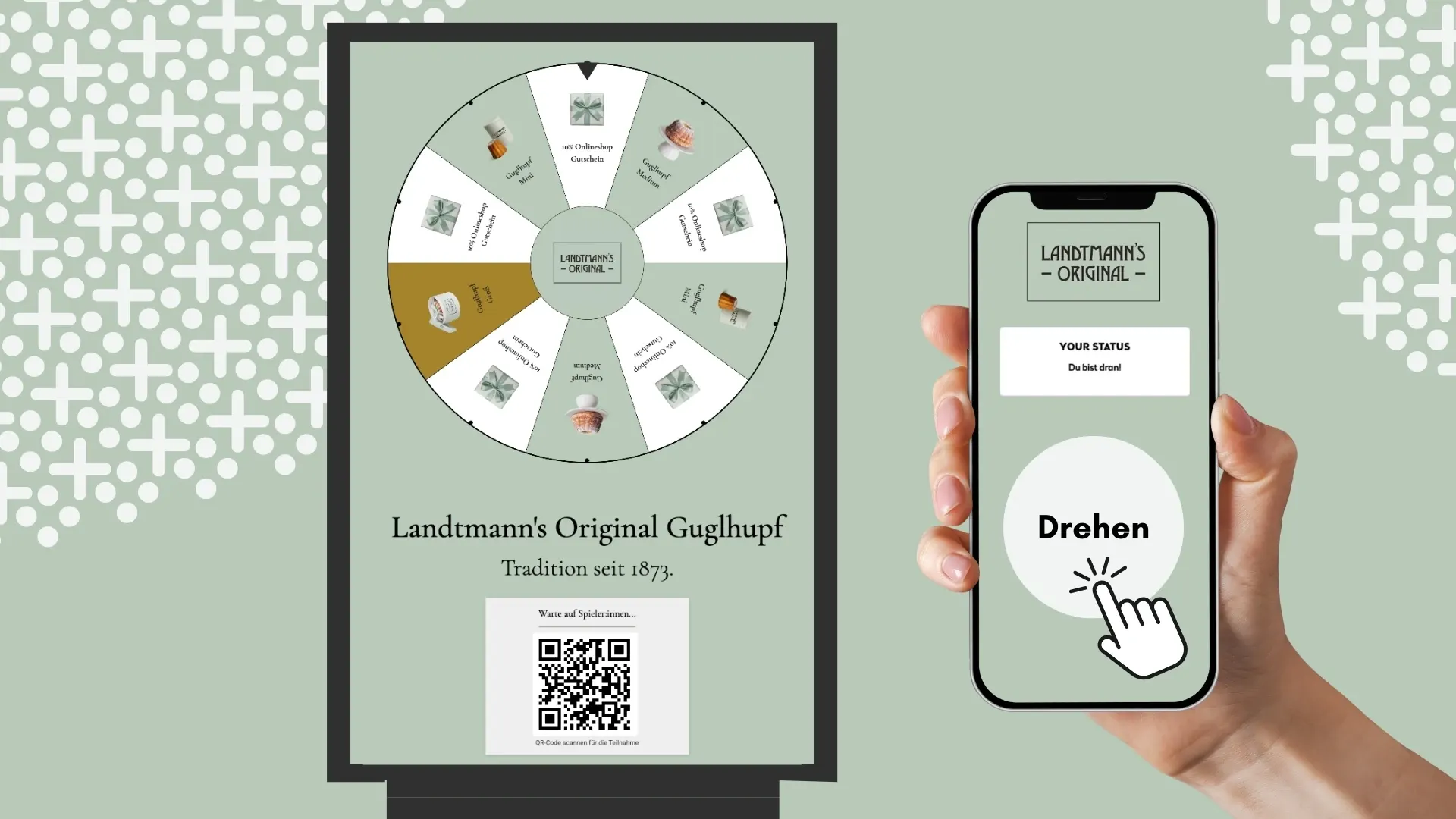
A giveaway is one of the most reliable reasons to stop at a trade show booth. Done digitally, with spin the wheel or a quiz on screen, it also brings contacts with consent instead of a box full of business cards. Before you start, it is worth looking at the rules, because a giveaway is advertising and is subject to competition, data protection and, in Austria, levy law.
Important: this post gives an overview and is not legal advice. As of October 2026. Clarify the details of your activation with your legal team or law firm. It covers Austria and Germany; other countries have their own rules.
Participation without a stake
The most important rule for trade show giveaways: participation is free. If people have to pay to take part, you quickly end up under gambling law, where completely different rules apply. A spin the wheel at the booth where visitors only enter their contact details is a classic promotional giveaway.
Can participation be tied to a purchase? In Austria, linking a giveaway to buying a product is generally permitted according to the Austrian Economic Chamber’s guide. In Germany, tying is no longer prohibited per se either, but it must not be misleading. At a trade show the question is usually theoretical anyway: without a purchase condition the barrier is lower, and that is the whole point at the booth.
Austria: a levy on giveaways decided by chance
A point many people are not aware of: in Austria, giveaways where winners are determined mainly by chance are subject to a levy under section 58(3) of the Gaming Act, even if participation is free. It amounts to 5% of the value of the prizes offered. If the levy stays below 500 euros per calendar year, that is with prizes up to around 10,000 euros a year, it does not apply. The organizer owes it, and it arises at the end of the calendar year.
If winning depends mainly on skill, such as the best high score or all correct quiz answers, that speaks against a game of chance. The distinction is always a matter of the individual case, though. Most trade show giveaways with prizes in kind stay below the threshold. If you run many activations a year, add up the prizes anyway.
Terms of participation
Terms of participation are mandatory, and they have to be understandable. In Germany, section 6 of the Digital Services Act (DDG) requires giveaways with an advertising character in digital services to be clearly recognizable as such, with terms that are easily accessible, clear and unambiguous. Missing terms can be anti-competitive under section 5a of the Unfair Competition Act (UWG). In Austria the same applies in essence: the terms must be clearly worded and must not mislead.
The terms of participation should at least cover:
- who the organizer is, with company name and address
- who may take part, for example from 18 and excluding employees
- time and place, meaning trade show, date and time
- which prizes there are and how many
- how winners are determined: instant win, high score or a draw after the show
- how prizes are handed over or collected, and by when
- a reference to the privacy information
At the booth, the best place to link the terms is where participants enter their details, right before the game. A short line on screen such as “18+ only, terms when you join” helps too.
Data and consent
To run the giveaway you may process the data you need for it, for example to notify winners. If you want to use the contacts for marketing afterwards, you need separate, explicit consent. For marketing emails this is governed by section 7 UWG in Germany and section 174 of the Telecommunications Act in Austria.
Whether marketing consent may be a condition for taking part is disputed. The GDPR requires consent to be freely given (Art. 7(4) GDPR). In 2019 the Higher Regional Court of Frankfurt (case 6 U 6/19) ruled that tying consent to a giveaway is not automatically unlawful if it is transparent what people consent to. Some supervisory authorities take a stricter view. The safe route is therefore a separate, optional checkbox for the newsletter or a call back, independent of participation. It costs a few opt-ins but makes the list reliable.
- keep required fields to the minimum, usually name and email
- word consent texts specifically: who, for what, via which channel
- point out the right to withdraw consent
- use double opt-in for the newsletter
In the GameHub you define the fields and consents per game. The data is stored GDPR-compliant in the EU and can be exported as CSV after the show.
In practice: a smooth giveaway at the booth
- Show the prizes. What can be won belongs at the booth, not just in the small print.
- Plan the prize pool. Decide how many prizes there are per day so nothing is left by the last show day. You set the prize pool and win probabilities per game in the GameHub.
- Hand over instant prizes at the booth. It is the best conversation starter for your team.
- Draw the main prize after the show. It keeps the suspense and gives you a reason for the first email.
- Brief the team. Who explains the flow, who hands out prizes, who answers questions about data protection?
Checklist
- Participation free and without a purchase condition
- Complete terms of participation, reachable before the game
- An age limit defined
- Marketing consent separate and optional
- In Austria: keep an eye on the yearly prize total because of the levy on games of chance
- A prize pool planned per show day
Which games work for a giveaway at the booth is shown in our overview of trade show booth games. Ideas sorted by goal are in Trade show booth ideas: 10 games that bring leads.
Sources: Austrian Economic Chamber (WKO), guide on giveaways, competitions and games of chance; section 58(3) Austrian Gaming Act; section 6 DDG; sections 5a and 7 UWG; section 174 Austrian Telecommunications Act 2021; Art. 7 GDPR; Higher Regional Court of Frankfurt, judgment of 27 June 2019, 6 U 6/19.
Want to try this idea as a campaign?
We translate the idea from this article into a concrete game setup, tailored to your channel and budget.
No obligation, on a video call