Ö3 Wake-Up Challenge on Screen: Interaction in Public Space
During the Ö3 Wake-Up Challenge, commuters at Austrian train stations could vote live via QR codes and use digital screens interactively, showing how screen advertising can create experiences instead of only displaying content.
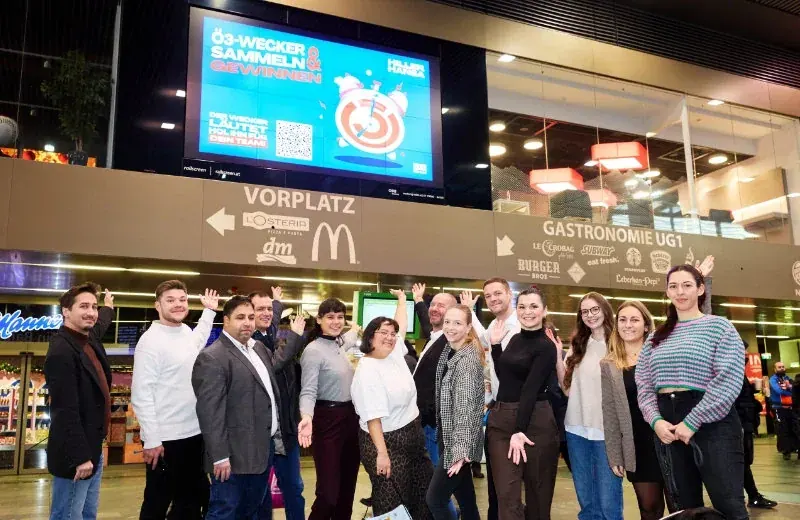
As part of the Ö3 Wake-Up Challenge: Hiller vs. Hansa, an interactive voting activation took place on November 20, 2025 at 18 train stations across Austria. Passers-by were invited via large digital screens in public spaces to use their smartphone and vote whether they were more Team Early Bird Hiller or Team Night Owl Hansa.
By scanning a QR code on the screens, people could participate directly at the display and vote in real time, without installing an app or additional software. This direct interaction between passers-by and screen shows how screen advertising can be more than just advertising. It becomes an active touchpoint for audience engagement.
The starting point
The Ö3 Wecker is the morning show many people in Austria start their day with. For the “Hiller vs. Hansa” challenge, the question of whether you are an early bird or a night owl was not only to be asked on the radio, but where people actually are in the morning: at the train stations.
How it worked
For the activation we built a dedicated voting module as a custom game. It ran on the DOOH screens at 18 train stations from Vienna to Innsbruck, at the main stations and other high-traffic locations. Between 5:00 and 8:30 a.m., commuters could vote via QR code and join one of the two teams.
- Joining in seconds: scan the QR code, pick a team, done. No download, no extra software.
- Live on screen: the interim result updated in real time, and every vote was visible immediately.
- Announced across channels: Ö3 announced the challenge beforehand on air, on the Ö3 website, on social media and with online ads.
The result
The result of the challenge was also communicated live: at 8:45 a.m., it was clear that 65% had voted for Team Hiller and 35% for Team Hansa. The vote from the stations became part of the show itself. A question on the radio turned into an activation that people all over Austria could join on their way to work.
For us, this activation is an example of how digital screens in public spaces can actively involve people. Simple interaction creates not only attention, but real participation and reach in an everyday context, right where people are on the move.
Why voting on DOOH screens works
Screen advertising at train stations has enormous reach but hardly any back channel. A vote turns that around: the people in front of the screen are no longer just an audience, they help decide what appears on it. For the brand, a playout becomes measurable participation; for commuters, it is a short moment that breaks up the way to work.
It needs no special hardware. The module runs as web content in the screen network’s existing player, and the smartphone is the remote control. That is why the same mechanic works for other questions too, from a product vote in retail to an audience vote at an event.
For advertisers, the activation also shows what screen advertising has long struggled to prove: how many people actually engaged with the message? With a vote the answer is simple, because every vote is a deliberate action and gets counted. Estimated contacts become counted participation.
What other campaigns can learn from it
- One question, two answers. Nobody on a platform has time for a long quiz. A simple either-or works in passing.
- Use the time window. The activation ran exactly in the hours when commuters wait in front of the screens and the Ö3 Wecker is on air.
- Make the result visible. People who vote want to see what happens. The live interim result on screen is the reason to take out the phone.
- Connect the channels. Radio, website and social announced the challenge, the screens turned it into an experience, and the radio revealed the result.
More details are in our Ö3 Wake-Up Challenge case. How games and votes run on DOOH screens is explained on the Screen Play page.
More about it:
Want to try this idea as a campaign?
We translate the idea from this article into a concrete game setup, tailored to your channel and budget.
20 minutes via video call, no obligation. We usually answer requests within 24 hours.