From Idea to Playable Experience in 72 Hours
Gamification often sounds like a large project. With ready-made modules and clear workflows, a branded game can be set up within a few working days.
Why speed is a competitive factor
Events, promotions and campaigns change fast. Anyone who starts a separate development project for every game is often too late or blows the budget.
That is why modern gamification platforms rely on ready-made, tested game modules that can be adapted quickly.
A typical path from idea to game
- Clarify the goal: attention, leads, education, sales?
- Pick a module: for example spin the wheel, quiz or symbol spinner.
- Deliver branding & content: logo, colors, copy, images if needed.
- Configuration & testing: campaign settings, test run, fine-tuning.
- Go live: roll out the link or QR code on screens, posters and materials.
Many setups are ready within two to three working days this way.
What happens in those 72 hours
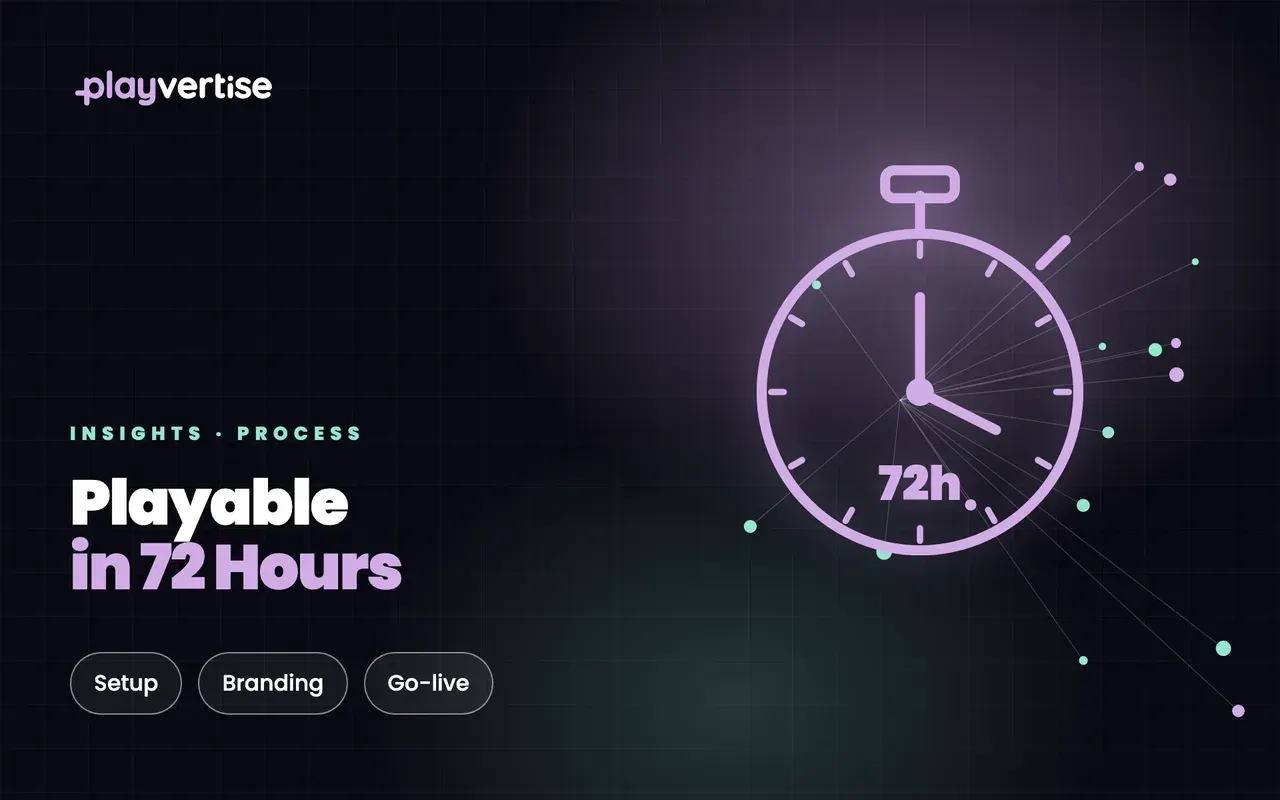
The 72 hours are not a promise for every project, but a realistic frame for games from the game library. Typically it looks like this:
- Day 1: goal and game. You clarify what the activation should achieve and pick the right game. For prize moments that is often spin the wheel or the scratch card, for product knowledge the quiz, for dwell time a reaction game like Catch Game.
- Day 2: branding and prizes. Logo, colors, sprites and copy go into the game, together with the prize pool, win probabilities and the lead fields with consent.
- Day 3: testing and go-live. A test run on the real screen or phone, final corrections, then the link and QR code go out.
If you work in the GameHub yourself, it is often even faster: a game from the library can be branded and published in a few hours.
What to prepare
In most projects the time does not go into technology but into waiting for content. Having these things ready saves days:
- your logo as a vector or in high resolution, plus brand colors and typeface
- copy for the start, a win and “no win this time”, and for a quiz the questions with answers
- the prizes with quantities, so the prize pool and probabilities add up
- terms of participation and privacy notices for lead capture
- details about the screen or channel: format, player, location and duration
Where fast projects stall
- Too many approval rounds. One person who decides on branding and copy speeds things up more than any technology.
- Unclear on-site technology. The screen needs an up-to-date browser and a stable internet connection of at least 10 Mbit/s. Ideally, test it once on the actual device beforehand.
- Too much at once. Better to start with one game and one channel and sharpen it after the first week.
Flexibility for bigger ideas
If you want more, such as your own mechanics, deep system integrations or special prize logic, custom solutions are the way to go. The advantage of the module base remains: many building blocks already exist and do not have to be reinvented each time. How such a project runs is shown on the custom games page.
Fast to the next trade show
Speed matters most before trade shows: the booth is booked, the graphics are done, and the idea for an activation only comes shortly before. That is what the flat price for a show of up to a week is for, without a monthly license: a game from the library such as spin the wheel or quiz with branding, lead capture and two screens. Which games work best is shown in our overview of trade show booth games.
What happens after go-live
Plays, prizes and contacts flow into the dashboard live from the first round. After the activation you export the contacts as CSV and know exactly how many people played. If the game keeps running on a license, the next activation is just a matter of new copy and prizes, not a new project.
Start, learn, scale
Instead of planning forever, it often pays to start with a manageable setup, measure the results and then think bigger. Gamification thrives on trying things out, and on the willingness to react to real data. Which numbers really count is covered in Gamification KPIs: what campaigns can deliver.
Want to try this idea as a campaign?
We translate the idea from this article into a concrete game setup, tailored to your channel and budget.
20 minutes via video call, no obligation. We usually answer requests within 24 hours.